Wisdom6 min read
Mencius and the Four Seeds: Pity, Shame, Deference, Judgement
Mencius said everyone has four beginnings: pity, shame, deference and a sense of right. What he claimed they are, and what he said you must do next.
By Wen Su — Writer & Editor
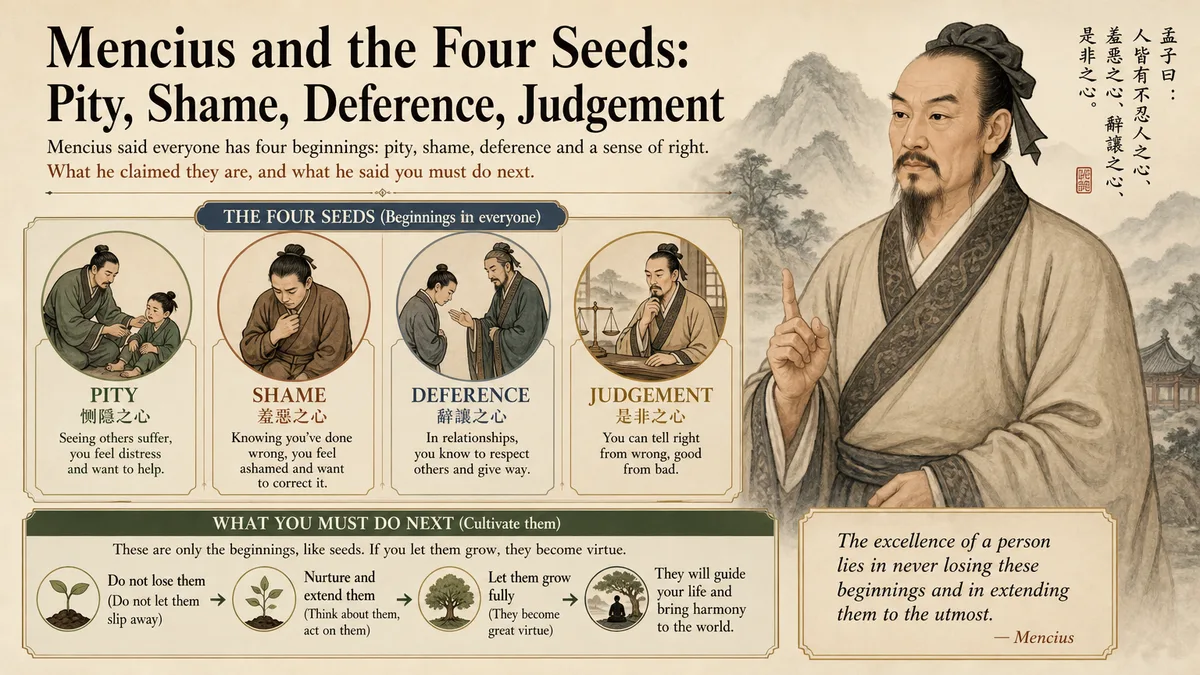
Mencius made one claim and spent a book defending it: human beings are not blank. Something in us moves before we decide anything.
The evidence he offered is a single scene, and it is the most quoted thought experiment in Chinese philosophy.
The Child at the Well
A small child is about to fall into a well.
Anyone who suddenly sees this, Mencius says, feels alarm and distress. Not because they want the parents’ gratitude. Not because they want credit from neighbours and friends. Not because they dislike the child’s cries.
The feeling arrives first and the reasons come later, if they come at all. And the suddenness is the whole argument. The phrase is zha jian, seeing it all at once, and it removes the possibility that the reaction was calculated.
That is the only proof he offers, and he builds everything on it.
The Four
From that scene he generalises to four reactions, each with a corresponding virtue.
The mind of pity and commiseration (ce yin) goes with ren, the humane.
The mind of shame and dislike (xiu wu) goes with yi, the right.
The mind of deference and yielding (ci rang) goes with li, the rites, the forms of courtesy.
The mind of right and wrong (shi fei) goes with zhi, wisdom.
He then says the thing that made the passage famous. Without the first, one is not human. Without the second, not human. And so on through all four.
What “Seed” Means
English translations use beginnings, seeds, or sprouts. The Chinese word is duan, and its plain sense is a tip or a starting point, the end of a thread you can take hold of.
The distinction matters, and Mencius draws it himself. He compares the four to the four limbs. Everyone has them. Having them is not the same as using them.
A seed is not the tree, and a limb is not the skill. What you have at the start is a capacity, and the gap between capacity and character is where the rest of the book lives.
What Has to Happen Next
If the seeds are enough on their own, nothing further is needed. Mencius says the opposite.
The verb he uses is kuo chong, to fill out and extend. Cultivate them and you can settle the whole realm, he says; neglect them and you cannot even serve your parents. The sentence is deliberately extreme, and it makes the seeds a starting condition rather than an achievement.
He is also clear about the failure mode. In another chapter he tells of a farmer from Song, unhappy that his seedlings were growing too slowly. The man went out and pulled each one up a little. He came home exhausted and told his family he had helped. By morning the field was dead.
The point is not that effort is bad. The point is that you cannot hurry a seed by pulling, and you cannot force a character by wanting it.
The Ox Mountain
The book’s darkest passage is about a hill.
Ox Mountain was once well wooded, Mencius says. Then the axes came, and then the cattle grazed the new shoots. Today it looks bare, and people assume it was always bare.
His argument is that the mountain’s nature was not barren. The damage was done by repeated use, and not by some original defect. He applies the image to people. Good impulses are worn down daily; a night’s rest restores something and the day takes it away again. After enough of that, people say of someone that they never had it in them.
The image is not consoling, and it is not meant to be. It says the seeds can be lost, not by one bad decision, but by the ordinary traffic of a life.
The Argument He Was In
Mencius is not describing common sense about human nature. He is taking a side.
A rival, Gaozi, argued that human nature is neither good nor bad, and compared it to water, which can be made to flow either way. Another line of thought, later and associated with Xunzi, held that people start out inclined toward their own interest and are made good by training and ritual.
Mencius’s four seeds is one position in a long argument, not the voice of China. Knowing that makes the passage easier to read. It is a case being made, forcefully, by someone who expected to be answered.
What to Do With It
Three uses, in the order they are worth trying.
Notice the first reaction. The child at the well is a test of attention. Something in you responds before your reasons arrive. Most of the time we skip past that response on the way to the explanation.
Do not confuse the seed with the virtue. Feeling pity is not the same as being kind. The seed is a starting point and it needs the long, dull work of extension.
Watch the grazing. Ox Mountain is not a story about a catastrophic fall. It is a story about repeated small uses that strip the ground, and about the way the result then looks like nature.
Common Questions
Does Mencius say people are naturally good?
He says they have four beginnings. The word he avoids is perfect, and he insists on cultivation, so the plain reading is closer to capable of good than good by default.
Why is deference one of the four?
Because courtesy is treated as a moral capacity, not a set of manners. Yielding to another person requires noticing them first.
Is this the same as Confucius?
It is a development of it. Confucius named ren as the central virtue; Mencius gives it a psychological origin and a supporting cast of three.
What is the child-at-the-well story proving?
That at least one moral reaction is immediate and disinterested. It is an argument from a single case, and Mencius builds on it rather than proving more.
Did the argument get settled?
No. The nature of human nature stayed contested in Chinese thought for centuries, and the disagreement is more interesting than a verdict.
A Start, Not a Verdict
The four seeds are a claim about where morality begins, and the least modern thing about them is how modest the claim is. Nobody is born kind. Everybody is born able to notice.
What follows is the long work the book keeps insisting on. The related essay on this site, the doctrine of the mean, is about the same discipline of not overshooting. If you want the earlier voice in the same tradition, start with the Analects for beginners. More sits in the Culture section.