Wisdom6 min read
Sunzi's Five Factors: The Way, Heaven, Earth, the Commander, Method
Sunzi opens the Art of War with five factors and seven reckonings. The list is a checklist for a state, not a motto, and that is what makes it usable.
By Ming Chen — Editor & Researcher
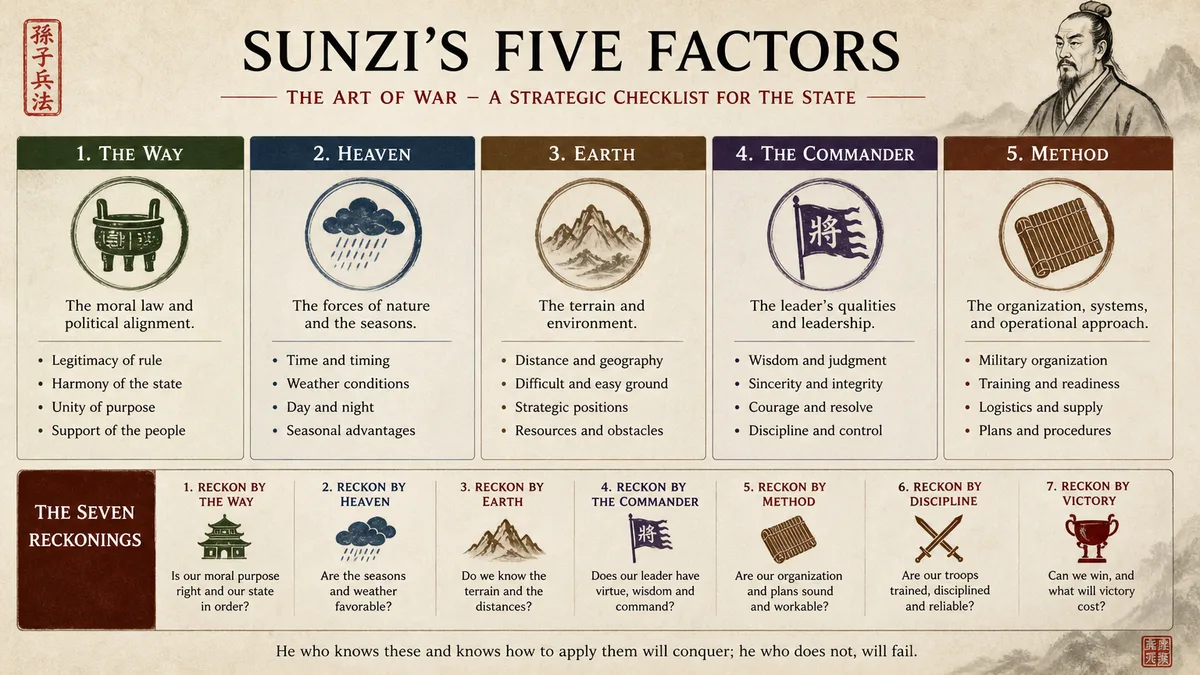
The Art of War does not begin with a maxim. It begins with an audit.
The first chapter sets out five factors to be weighed before a campaign, and then seven comparisons to be scored. Only after that does Sunzi talk about deception, which is the part everyone quotes.
The Chapter That Opens With a List
Five factors, in the order the text gives them: the Way, Heaven, Earth, the commander, method.
Dao, tian, di, jiang, fa. Read quickly, they sound like a slogan. Read as a set of headings, they are a checklist, and each heading asks a question a ruler could actually answer or fail to answer.
The Way
The first word is Dao, usually translated as the Way, which is unhelpful, because the same term appears in the Tao Te Ching meaning something else entirely.
Here it is defined by the text, and the definition is narrow: when the Way is present, the people are of one mind with their ruler. The common formula is that they will follow him into danger without fearing it.
The claim is not moral. Sunzi is not saying a just cause wins. He is saying that a population which accepts the purpose of a war will hold together, and one that does not will come apart at the first reverse. The Way is alignment, and alignment is measurable: it shows up as willingness.
Heaven
Heaven means weather and calendar.
The pair yin and yang is named here in its plain sense, cold and heat, night and day. Then come the seasons and the times. The point is that a campaign has a season, and marching in the wrong one costs you the army before the enemy does.
This is less mystical than it sounds. It is logistics with a calendar attached. Rivers flood. Roads turn to mud. Conscripts are needed at home for the harvest.
Earth
Earth is terrain, and Sunzi gives four pairs: distance and nearness, difficulty and ease, breadth and narrowness, and the ground of life and death.
The last pair is the one to hold on to. Some positions can be held and some can only be left. Knowing which one you are standing on is the difference between a position and a trap.
The later chapter on ground goes much further, naming nine kinds of terrain and what to do on each. The seed of all of it is here in four pairs of words.
The Commander
Five qualities, in a fixed order: wisdom, trustworthiness, benevolence, courage, severity.
The order is the argument. Judgement comes first, and severity comes last, and severity without the other four is just a temper. Sunzi has nothing good to say about a commander who is brave but stupid; he lists the five faults of generals later, and recklessness is one.
Note also what is absent. There is no requirement of nobility, and no requirement of strength. This is a job description, not a hero.
Method
The last word is Fa, and it covers what a modern reader would call organisation: how units are structured, how the chain of command runs, and how supply is managed.
The Chinese terms are technical and slightly obscure. What they describe is an army that can be given an order and will execute it, in the right size of unit, with food arriving. Boring, and the factor that decides most campaigns.
The Seven Reckonings
Having listed five factors, the text immediately converts them into seven comparisons, scored for each side.
Whose ruler has the Way? Whose general is more able? Who has the better ground and weather? Whose rules are actually enforced? Whose army is stronger? Whose soldiers are better trained? Whose rewards and punishments are clearer?
Seven questions, answered twice, once for each side. That is the audit, and it produces a number.
The famous line follows: the side that reckons more before the battle wins; the side that reckons less loses. And the calculation happens in the temple, before anything moves.
What the Framework Is For
The purpose of the audit is not to win the battle. It is to decide whether to have one.
Sunzi’s stated ideal is to take a state whole, without fighting for it, and he is explicit that a long war ruins the winner too. A framework that makes you count your disadvantages before you commit is a framework for restraint. That is the least quoted and most useful thing in the book.
Where It Gets Misused
The five factors are now standard in business books, and the transplant is rougher than it looks.
An army can be ordered and a market cannot. Soldiers accept a purpose; customers have to be persuaded. And Sunzi’s whole setting is deception between states, which is not a comfortable model for a company’s daily conduct.
The part that survives translation is the audit itself: name the five things, score both sides honestly, and let the score change the plan. The part that does not travel is the assumption that the other side is an enemy to be deceived.
Common Questions
Is the Way the same as the Tao of Taoism?
No. The character is the same and the meaning is local. In the Art of War it means the alignment between a ruler and the people he leads.
Why does Heaven come before Earth?
Because weather changes the plan and terrain sets it. The sequence runs from the most general condition to the most fixed one.
Are these five things ranked?
Not as importance, but as scope. The Way covers a whole population, method covers a supply train.
Did Sunzi invent the list?
The text presents it as a received framework rather than a novelty. Lists of five were a common way of organising an argument in the period.
Can you use it for a personal decision?
Partly. Judgement, trust and the state of the ground all apply. Deception does not, unless the decision is a competition.
Five Headings, One Question
The list is easy to memorise and hard to answer honestly, because four of the five factors are things you would rather not count.
Which is the point. A commander who scores himself generously has already lost the argument the chapter is trying to have with him.
The neighbouring essay on this site takes the same book into a much smaller arena, the art of war applied to ordinary conflict. For the other classical use of a fixed list of stages, read Confucius on turning fifty. More of this line sits in the Culture section.