Wisdom5 min read
The Giant Gourd: Zhuangzi on Being Clumsy With Big Things
Huizi grew a gourd so large that he smashed it. Zhuangzi's reply is about scale, framing and one very useful hand salve, and it is still funny.
By Ming Chen — Editor & Researcher
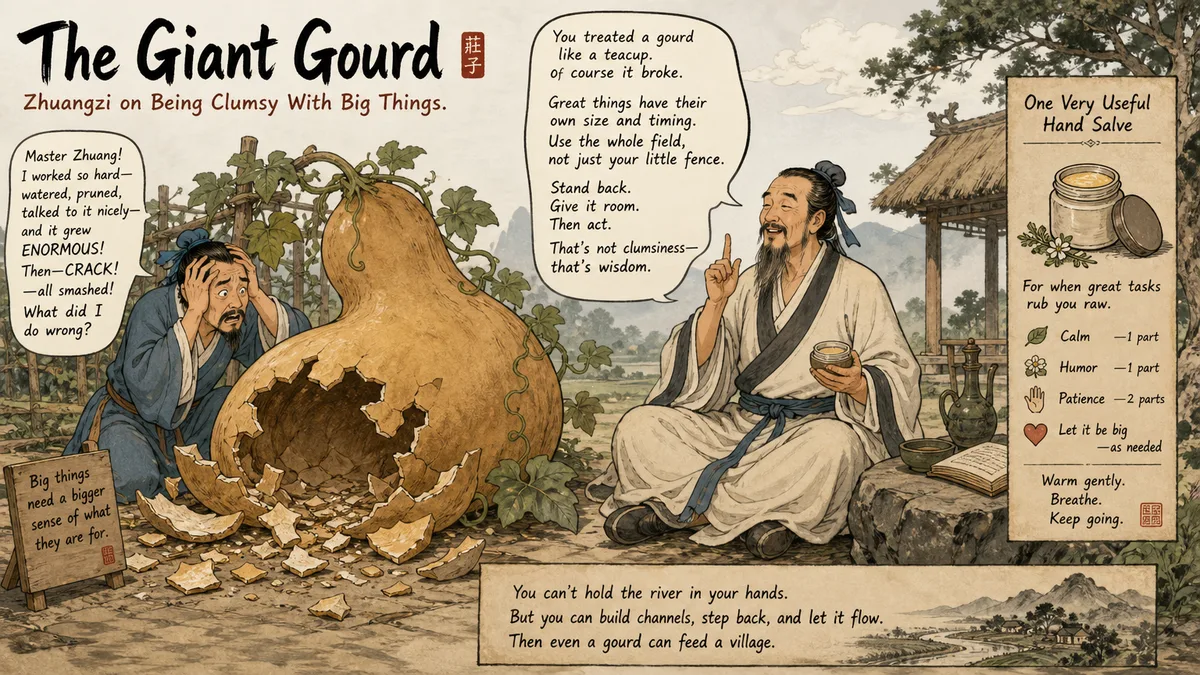
A friend complains about a vegetable. Zhuangzi’s answer is one of the funniest passages in Chinese philosophy, and one of the most misread.
It appears in the first chapter of the Zhuangzi. The argument is between two named men, and it is not a fable with a moral pinned to the end.
The Complaint
Huizi tells Zhuangzi about a gourd.
The king of Wei gave him seeds, he says, and the plant produced fruit with a capacity of five piculs. Too big for anything. Filled with water, it was not strong enough to lift. Cut in half as a ladle, it was so wide and shallow that nothing would stay in it.
It was not small. It was useless. So he smashed it.
Everything in the complaint is a measurement. Capacity, strength, depth. Huizi is not a fool; he is a practical man who has tested the object against the jobs a gourd is for, and it failed all of them.
The Reply
Zhuangzi’s first line is not gentle. You are, he says, clumsy at using big things. Zhuo yu yong da: clumsy at using big.
That is the thesis of the whole passage, and it is worth noticing what it accuses Huizi of. Not stupidity. Not greed. Clumsiness, at a specific scale.
The Hand Salve
He then tells a story that appears to have nothing to do with gourds.
A family in Song made a salve that kept hands from chapping. They used it in their own trade, which was washing silk floss in river water, a winter job that ruins hands. Generations of them, for very little money.
A stranger hears about the salve and offers a hundred gold for the recipe. The family gathers and does the arithmetic: generations of washing silk for a few coins, against a hundred gold for the formula. They sell.
The stranger takes the salve to the king of Wu, who is about to fight the state of Yue. Winter, water, boats. The salve goes to the soldiers on the water, the campaign is won, and the stranger is given land and a title.
Same salve. One use keeps a family at the wash vats. The other wins a fief.
The line that follows is the hinge of the passage. Keeping hands from chapping was one ability; some used it to be enfeoffed, and some did not escape the washing vats. The difference was in the use.
Back to the Gourd
Only then does Zhuangzi return to the vegetable.
You had a gourd with a capacity of five piculs, he says. Why did you not tie it up as a great float and drift on the rivers and lakes, instead of worrying that it would not hold anything? You had a big thing, and you complained it could not do a small job.
The last phrase is the joke and it is untranslatable without a footnote. He says his friend’s mind is still full of peng — reeds, or tangled brushwood. Stuffed with matter, no room to float.
What the Story Is Doing
Read as a lesson, the passage gets flattened into “be creative”. That undersells it.
Three things are actually happening.
First, usefulness is not a property of the object. The salve did not change between the wash vats and the war. The frame did.
Second, scale changes the category, not just the size. A gourd the size of a bucket is a bucket, and the only sensible question is whether it holds water. A gourd the size of a boat is not a worse bucket. It is a boat. Huizi tested it against the old job and found it deficient, which is exactly backwards.
Third, this is an argument between friends, and Zhuangzi is being a bit of a show-off. He stacks a pun, a folk story and an insult into four sentences. The tone matters, because the passage is often quoted as serene wisdom when it is closer to a well-aimed jab.
The Second Half of the Argument
Huizi does not concede. He comes back immediately with another object: a huge, gnarled tree, too crooked for timber and too bitter to eat.
Zhuangzi answers that one too, and that reply has its own essay on this site: the tree nobody cut down. The two halves belong together. One argument is about a thing too big to use, the other about a thing too crooked. In both cases the answer is to stop asking the timber merchant’s question.
What It Does Not Say
It does not say that size is better, or that everything has a use if you are clever enough. Zhuangzi is not that comfortable.
It also does not say that Huizi was wrong to smash the gourd. There is a real cost to a five-picul gourd: it occupies space, it has to be carried, and it is not food. The passage simply refuses to let that be the only question.
Common Questions
Where is this passage?
The first chapter of the Zhuangzi, the chapter usually translated as Free and Easy Wandering. The gourd story comes immediately before the big tree story.
Who was Huizi?
A logician and a friend of Zhuangzi’s. He appears several times in the book, usually as the straight man, and usually with a good argument.
Is there an idiom from it?
Several expressions come from the passage, including the phrase for being clumsy with large things. The gourd itself is less of a fixed idiom than the tree.
Does the salve story have a moral?
Only the one Zhuangzi draws: the same ability, differently used, produces very different lives. He does not say which use was better.
Is it about ambition?
It can be read that way, and often is. The more literal reading is about categories: the mistake is not aiming too high, but measuring a new kind of thing with an old kind of ruler.
The Question to Keep
The passage leaves you with a question rather than an answer. Which of the things you have written off as useless were measured against a job that no longer applies?
Most people who quote the gourd are thinking about ambition. Zhuangzi, who was rude about it, was thinking about categories.
More of the same hand is in the parables of Zhuangzi, and the longer autumn dialogue is here. The wider collection sits in the Culture section.