Wisdom6 min read
The Old Woman Who Runs the House: Age in Dream of the Red Chamber
Dream of the Red Chamber is read as a book about youth and a garden. Its most powerful person is an eighty-year-old woman. What the novel says about age.
By Wen Su — Writer & Editor
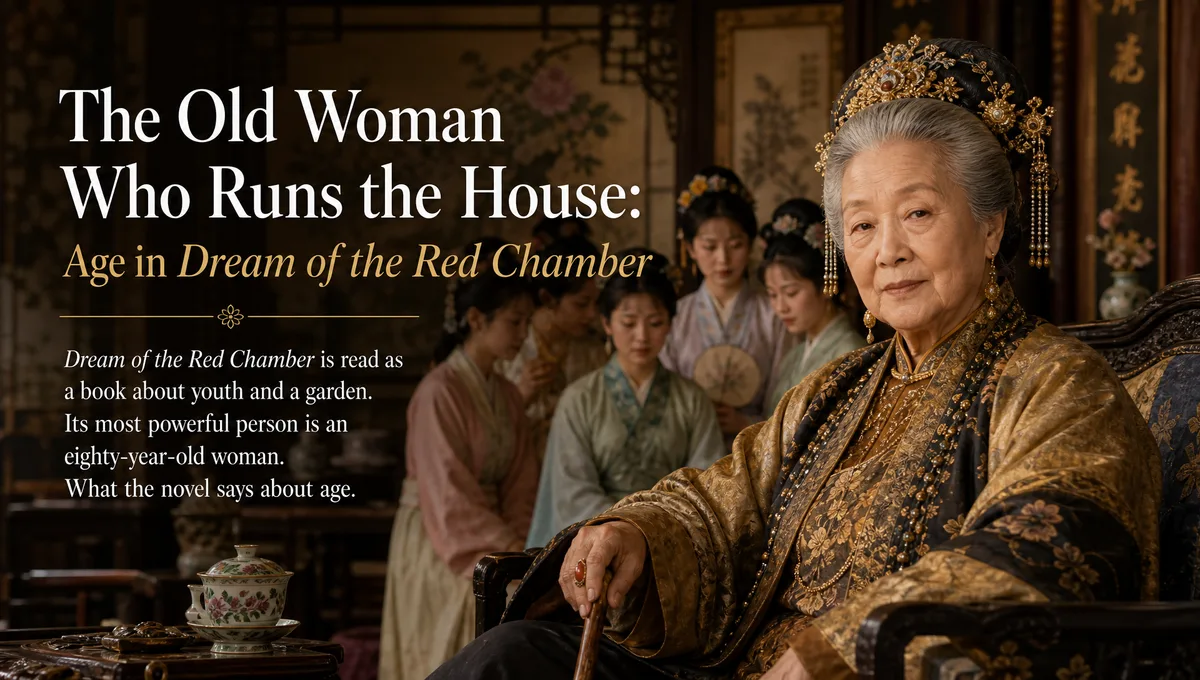
Dream of the Red Chamber is usually described as a book about young people. A boy who does not want to study. A girl who writes poems with a cough in her voice. A garden full of cousins who have one good spring before everything falls apart.
That reading is accurate, and incomplete. The most powerful person in the novel is an old woman, and two other old women carry some of its heaviest scenes. Read with age in mind, the book says more about the last third of life than most novels of its century.
The Oldest Person in the House Runs It
Grandmother Jia, born into the Shi family, is in her eighties. Chapter 71 gives her a birthday celebration for the eightieth year, and titled guests come to offer respects. She does not manage money or paperwork. Wang Xifeng does that, and reports to her.
Her power is of a different kind. Every scene she enters reorganises itself around her. People stand when she arrives, laugh at her jokes whether or not they are funny, and adjust their plans when she says she would like to hear the opera. Nobody in the household can override her, including her son.
That is worth noticing, because it is not longevity that produces the authority. The household defers to her, and the deference is the authority. An old person without that agreement is just old.
What She Is Good At
Her first skill is enjoyment. She eats, drinks, plays cards, listens to music and organises outings at an age when the culture around her expected quiet. The novel treats this as a virtue rather than as indulgence.
Her second skill is reading people. When her son wants the maid Yuanyang as a concubine, Grandmother Jia sees exactly what the request is about, and her anger is precise rather than sentimental. She knows which daughter-in-law is competent and which is not. She knows that Baoyu needs protecting from his own family.
The combination is rarer than it sounds. Plenty of old people in fiction are wise or cheerful. She is both, and still capable of a hard decision in the same afternoon.
Granny Liu: The Other Old Woman
Liu Laolao is a rural widow with no money and a distant claim on the family through marriage. She arrives at the mansion to ask for help, which the novel calls da qiu feng, and she is not proud about it.
Her second visit is famous. She is taken into the garden, dressed up, fed dishes she has never seen, and made the butt of a comedy that the young ladies enjoy enormously. Then Wang Xifeng sends her home with silver, cloth and a bundle of food, and she goes home.
Reading this scene as pure humiliation misses what she is doing. She understands the joke and plays along, because the payment is real and her household needs it. She is the most competent person in the room about the thing that matters, which is survival.
Much later, when the family collapses, it is Granny Liu who finds the household’s abandoned daughter and buys her back. The old woman from outside the gate turns out to be the only network that held.
Old Servants: Standing and Licence
Lai Momo is a nurse of the older generation whose family has served the house for decades. Her grandson is appointed to a magistracy, which means a servant family has produced an official. She speaks to her masters with a familiarity nobody else dares, and they let her.
Jiao Da is the other side of the same coin. He followed the founding duke to war and carried him out of a battlefield. Drunk, in chapter 7, he shouts the family’s secrets in the courtyard.
Both are old, and both are allowed a licence that younger servants are not. Age buys a kind of immunity, up to a point. Jiao Da is silenced with a mouthful of mud, and the incident shows where that immunity ends.
What the Novel Does Not Pretend
The book is not selling a comfortable old age.
Grandmother Jia dies while the family is being dismantled, in a house no longer able to protect anyone. Li Wan is not old, but she has been a widow since her twenties. She spends decades in grey clothes. The ceremonial title arrives after her son succeeds, too late to change anything.
The pattern is consistent: age in this novel is not rewarded for its own sake. What people have at the end is what their relationships and their money allow them to have, and no more.
Three Things Worth Taking From It
Authority is an agreement, not a number. Grandmother Jia is obeyed because the household has decided to obey her. Where that agreement is missing, as with Jiao Da, old age offers no protection at all.
Pleasure is a skill. She keeps her appetite and her curiosity deliberately. The people around her who stop wanting anything age faster than she does.
Keep one connection outside the household. Granny Liu is a thin thread to a world with no obligations to the Jia family, and it is the thread that saves a child at the end. A relationship maintained for its own sake, and not for what it returns, is the closest thing to insurance the book offers.
Common Questions
How old is Grandmother Jia? Her eightieth birthday is celebrated in chapter 71, so she is around eighty for most of the novel’s later half. She dies in chapter 110.
Is Granny Liu a relative? A very distant one, through an ancestor’s marriage. The connection is thin enough that the family has to be reminded of it, and thick enough that she can ask for help.
Why would a novel from the 1790s be useful to a reader over fifty? Because it is honest about the mechanics of late life. Deference, appetite, money and one good outside relationship decide more than age does.
Does Li Wan count as an old person? No, and that is the point of her. She is treated as finished at twenty-something, which lets the novel show how age can be assigned rather than reached.
Why does Jiao Da dare to shout? Because he carried the founder off a battlefield. His standing comes from a debt the family cannot repay, and the family’s reaction shows how quickly such debts are forgotten.
An Old Woman at the Center
A book that begins with a stone and ends with snow still finds room for an eighty-year-old who wants to hear one more opera. That is not decoration. It is the novel’s argument that a long life is a set of relations, kept up on purpose.
If you want the book itself, the guide to the four classic novels explains where to start. Our pieces on poems about aging and what filial piety means now take the same question from other angles.