Arts6 min read
Go, Part Two: Ko Fights and the Endgame
The opening gets the attention. Most amateur games are decided later, in a ko fight and a slow count. A guide to the half of Go that beginners skip.
By Wen Su — Writer & Editor
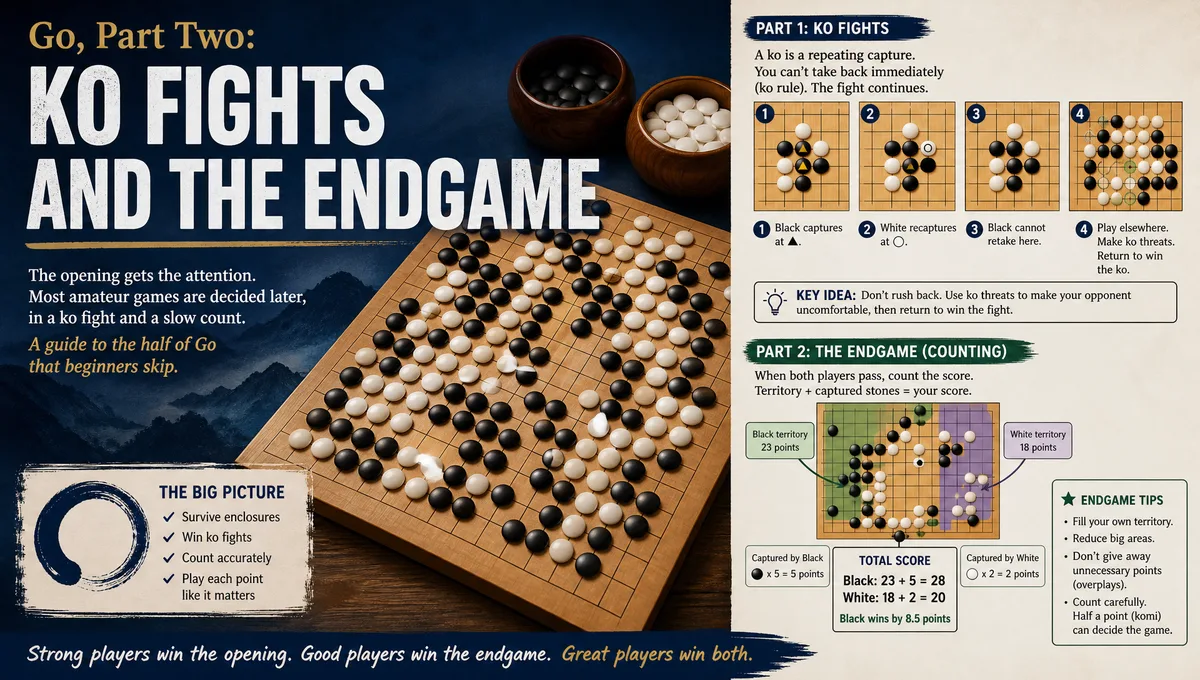
Beginners spend their first months on the opening. Corners, then the sides, then the fight in the middle. It is the part with the diagrams in the books, and it feels like the real game.
Then they lose, and the reason is almost always in the last forty moves.
This piece is about the half of Go that gets skipped. If the rules are still new, start with the beginner’s guide first.
Ko: The Rule That Stops a Loop
The ko is the strangest rule in the game. It exists to stop an infinite argument.
The position is small. Two stones sit in each other’s grip, and each could be captured by the other on the next move. Without a rule, the two players would take and retake the same point forever.
So the rule forbids the immediate recapture. After taking the ko, you must play somewhere else first. If that somewhere else is serious enough, your opponent has to answer it. Then the ko is available again.
The moves played elsewhere are called ko threats. This is where the game stops being about shape. A fight over three points in one corner gets decided by what is happening on the other side of the board.
There is etiquette attached. In casual play, the custom is to say da jie, announcing the capture. It gives a beginner a chance to notice the ko rather than discover it three moves later. In serious games the announcement is silent, and the threat-counting is brutal.
Guanzi: The Long Counting
The endgame is called guan zi. It is where a close game is settled.
By this stage the groups are alive and the map is drawn. What remains is a series of boundaries, each worth a known number of points. The question is who plays where, and in what order.
Two ideas carry most of the weight.
Sente and gote. A sente move is one your opponent has to answer. A gote move is one they can ignore. That difference is worth far more than the raw size of a single move. A sente move lets you keep moving.
The order. Big before small. Sente before gote. Double sente, the moves that are sente for both players, before anything else. Playing the correct endgame order can be worth ten points.
Why Amateurs Lose Here
The reason beginners lose in the endgame is not calculation. It is attention.
The middle game is exciting, and it produces a feeling of progress. The endgame produces nothing but small numbers. Most players start playing it casually, in whatever order the moves appear. The opponent, equally bored, does the same thing back. The game is then decided by whichever of the two was slightly less bored.
There is a second reason, and it is harder to fix. The endgame rewards patience and punishes pride. A player who is behind often keeps fighting in a lost position. Count honestly and play the biggest remaining move, and the same player does better. The advice from experienced players is blunt: count, play the biggest move, count again.
Counting Without a Scoreboard
Nobody carries a scoreboard, and precise counting is not the point at this level.
What works is a rough count at three moments. Around move 100, ask whether you are ahead or behind, and by roughly how much. Around move 150, do it again. At move 200, you should already know the answer, because the last fifty moves are about converting it.
The reason this matters is psychological. A player who does not count plays as if the game is close, whether it is or not. A player who counts knows when to take risks and when to close it out calmly.
Two habits make the estimate easier. Count in round numbers, in blocks of five or ten. And count the same way every time, so that the errors at least stay consistent.
Counting: How It Differs
The two main counting systems produce the same winner, which surprises people.
Chinese rules, shu zi (area counting), count area. That means the stones you have on the board plus the empty points they enclose. Japanese rules, shu mu (territory counting), count territory plus prisoners captured.
This is why the two traditions disagree about filling your own territory at the end. Under shu zi it costs nothing. Under shu mu it costs a point. It is a difference of convention rather than of result.
For a beginner, the practical suggestion is to pick one and stay with it. Chinese rules are slightly easier to count with a full board in front of you.
Hand Talk, and Why the Game Suits Slowness
Go is sometimes called shou tan, hand talk. The name is old, and it captures what the game is. A conversation carried out by placing stones, in which nothing is said and plenty is understood.
It also explains why the game has a following among older players. Along with the zither, calligraphy and painting, Go belongs to qin qi shu hua, the four arts of a cultivated person. The tradition treats these as the four accomplishments of a cultivated person. Three of them are quiet, and one is competitive in a very slow way.
Go rewards timekeeping over speed. Long games on a full board are lost by the player who tires. Our pieces on the guqin and on brush calligraphy cover two of the other quiet skills.
How to Practise the Endgame
Three habits will do more for results than any opening study.
- Play the last fifty moves twice. Go back over the endgame afterwards, in a review, and find the biggest move you missed. It is almost always a sente move you played as gote.
- Count before choosing. Not a precise count. A rough one, answering a single question: which of these two moves is bigger, and by about how much.
- Learn five standard endgame shapes. The common boundaries repeat endlessly. Five patterns will cover most of what you meet in a club game.
Common Questions
What is a ko, in one sentence?
A local position where two players could capture each other forever. The rules break it by forbidding the immediate recapture.
What is a ko threat?
A move elsewhere that is serious enough that your opponent must answer it. It buys you the right to come back and retake the ko.
Why is the endgame worth studying?
Because close games are decided there, and because it is the part most amateur players have never practised.
Is xian shou the same as sente?
Yes. It means a move the opponent must answer. Hou shou, gote, is a move they can safely ignore.
Which counting system should I use?
Either, as long as you keep to one. Both give the same result. Chinese counting is slightly easier with a full board.
More of this sits in the culture & arts section.