Wisdom9 min read
Wu Wei and Money: Not Chasing, Not Betting, Not Leaking
A Taoist reading of the ledger: what wu wei says about chasing, betting and leaking — three money habits that cost most after fifty.
By Ming Chen — Editor & Researcher
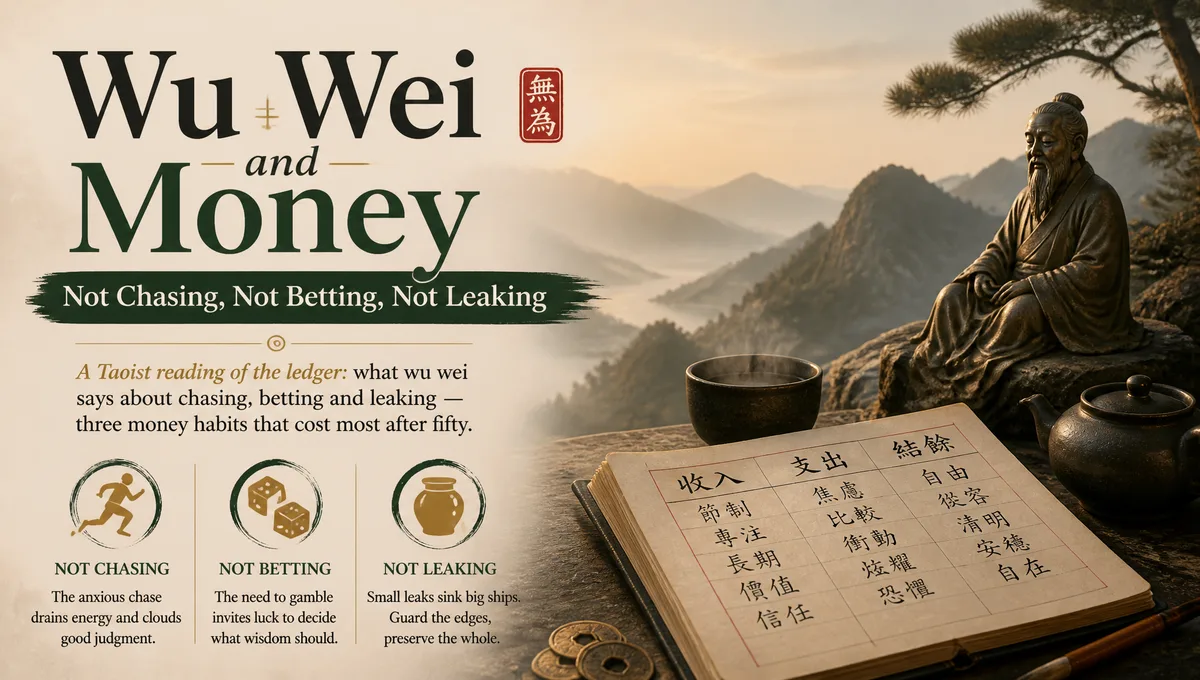
Most money advice shows up with a verb attached. Earn more. Grow it faster. Protect what you have before the window closes.
The Taoists were never much interested in the verb. They cared about how you stand while you do it. Wu wei gets translated as non-action, which sounds like doing nothing with your money. It is not that. It is closer to not forcing — not adding effort once the effort starts fighting back.
For anyone past fifty that matters, because by then the chasing costs more than it returns.
What Wu Wei Is Not
People read the phrase as “do nothing”. In the Tao Te Ching it sits closer to “not acting against the grain of things”. Water does not push a river downstream. It takes the ground it was given and gets there anyway.
Put that against a household account and it is not an argument for leaving the statements unopened. You still look at the balance. You still know what goes out. What shifts is both smaller and bigger than that: the money stops being a score and goes back to being a tool.
A score needs a number, and the number never quite arrives. A tool just needs a job.
This is a cultural reading of a classical text, not financial advice. For decisions about your own money, speak with a licensed professional.
The Expensive Part Is Not What You Buy
The Tao Te Ching ends on the sage who does and does not compete. Four characters: wei er bu zheng.
Chasing has a face. A neighbour’s investment group that comes up at every dinner. A relative mentioning that something has “gone up a lot” and asking, in a perfectly reasonable voice, why you are not in it. The private number you promised yourself would finally stop the worrying once you reached it.
None of those scenes is really about money, which is worth sitting with for a second. The chase is about keeping up, and about the belief that one more push will settle something that was never about the push.
The Taoist move is not to argue with any of it. You notice the shape of the impulse, then you notice what it actually costs.
After fifty, that cost is rarely money. It is attention — the afternoon you do not get back.
A Plain Test Before You Buy Anything
Chapter 44 of the Tao Te Ching says: zhi zu bu ru, zhi zhi bu dai, ke yi chang jiu. Know what is enough and you avoid disgrace. Know when to stop and you avoid trouble. That way you last.
“Know when to stop” needs a line, and there is an honest one: can you explain, in ordinary sentences, how the thing makes money?
If the answer comes out as a story about other people buying in later, that is not an explanation. If it comes out as a chart, or as someone else’s confidence, or as a feeling that the timing is right, that is not an explanation either.
Try it out loud, to a friend who is not impressed by any of it. The friend does not need to agree with you. The test is whether you can get through the paragraph without reaching for a phrase you cannot define.
The tradition does not mind what you decide. It only asks that the decision be yours.
The Small Holes
Money does not usually leave in one dramatic amount. It leaves in small monthly ones.
A subscription taken out for a single project. An automatic renewal you do not remember agreeing to. Two cards kept for years because closing them feels like paperwork. Each is trivial on its own. Together they put a floor under your spending that you never chose.
Chinese families kept an old habit that answers exactly this. At weddings, at funerals, at the big turning points of a life, gifts were written down. The book stayed for years. Who came. What they brought. What you owed back, and to whom.
The li bu, the gift ledger, looks like a debt book, and reading it that way misses the thing. People did not write the amounts down so they could collect. They wrote down the relationships, so that care could be remembered and returned. The list was there to help the memory, not to balance an account.
Worth borrowing as is: a written page instead of a vague feeling. Once something is written down you can decide about it; what lives only in the head just nags.
Round Outside, Square Inside
Old Chinese coins were cast round, with a square hole through the middle. The hole was not philosophy. It was how the blanks were made: a square rod ran through them so a stack could be held and filed at once.
The folk reading arrived later. Wai yuan nei fang, round outside and square inside, became shorthand for a person — easy in company, firm underneath. Someone who can bend in a conversation without bending on the thing the conversation is about.
It is a good reading. It is still a reading, and it is worth saying so. This site tries to keep the two apart everywhere: first how the object was made, then the meaning people put on it afterwards.
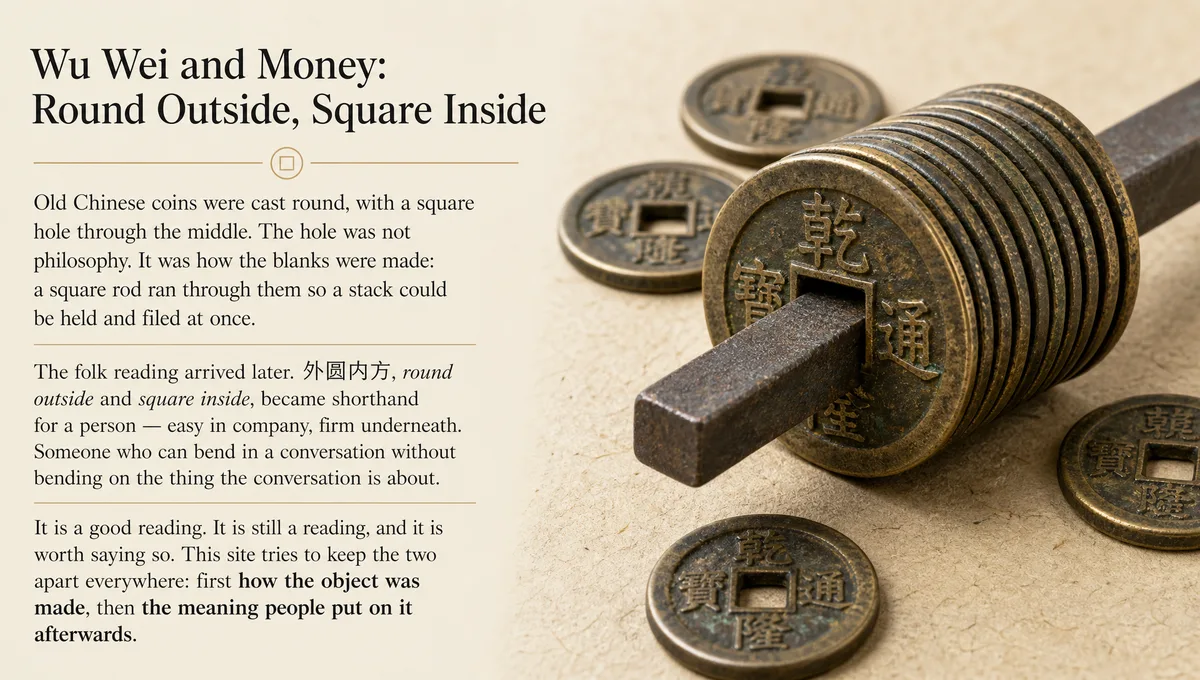
The coin does one more useful thing. It shows how to hold two things at once. The circle is the part that meets the world; the square is the part that stays put.
One Branch, One Belly
The Zhuangzi opens with the sharpest sentence in the tradition about how much is enough.
Xu You is offered the empire and turns it down. His reason is two small images: jiao liao chao yu shen lin, bu guo yi zhi; yan shu yin he, bu guo man fu. The wren nests in a deep forest and uses one branch. The mole drinks from a river and fills only its belly.
One branch. One belly. Everything else is forest and river.
For a reader past fifty, the sentence quietly swaps one question for another. Instead of asking how much more you need, it asks what full actually looks like. The first question has no ceiling. The second can be answered on a single page.
Our piece on Zhuangzi’s four parables takes this further, including the tree that was useless in exactly the right way.
Three Questions Nobody Answers for You
Chapter 44 begins with three questions, and they are often better left standing than answered.
Ming yu shen shu qin? Shen yu huo shu duo? De yu wang shu bing?
Which is closer to you — your name or your body? Which is worth more — your body or your goods? Which is worse — gaining, or losing?
Laozi goes on to answer them. The reader does not have to. The questions do their work on their own, and they are worth rereading at the end of a week when something arrived that you wanted for a long time.
The third one feels less obvious than it looks. The three lessons of autumn cover the same ground from another side. What to collect. What to leave. What a season of letting go is actually for.
Three Small Things
Each of these takes under twenty minutes and needs nobody else.
Measure your belly. Not the ideal number. Last December’s actual spending — any month you can still find records for. That figure is as close as you will get to an answer for “how much is enough”.
Find the leaks. List every automatic payment on every account. Keep three. If there is a fourth you genuinely use every week, keep it too, and notice how hard it was to say so.
Write one page of ledger. This year’s gifts, favours and help given, all on one page. What you received goes in the same list. It is memory, not accounting.
None of this asks you to change a single holding. It only makes the situation visible, which is where the tradition tends to start anyway.
What This Page Is Not
It is not financial advice, and it recommends no product, platform or strategy. Rates and returns do not appear here on purpose.
It is not an argument that money does not matter, or that being poor is somehow wiser. The Tao Te Ching says zhi zu zhe fu — the one who knows what is enough is rich. That is a sentence about order, not about the amount.
And it promises nothing. Nothing here will make anything rise or fall. It is one reading of a text that people have been reading for a very long time.
Common Questions
Is wu wei just doing nothing?
No. It is not forcing. Water in a river does no pushing and still gets where it is going.
Does the Tao Te Ching disapprove of making money?
It disapproves of not knowing when to stop. The same book calls the person who knows what is enough rich, and that is not a sentence about income.
Is “know what is enough” just comfort for people who have less?
It is about order, not quantity. Two households with the same income can hold that number in completely different ways.
Why do Chinese families keep a gift ledger?
Because relationships need to be remembered, not counted. Writing them down is how care given years ago can still be recognised.
Was the square hole in old coins a symbol?
The hole was for casting — a rod went through it in the workshop. Reading it as wai yuan nei fang, flexible outside and firm inside, came later. It is a folk reading, and a good one.
The Pushing Is Optional
The tradition never asks you to stop caring about money. It asks you to notice how much of the effort is actually working, and how much is just strain.
Three habits cover most of it. Do not chase whatever everyone else is already discussing. Do not buy anything you cannot explain in a plain sentence. Do not let small automatic payments set your floor for you.
Then go back to the three questions and leave them open if they want to stay open. The wider idea of wu wei is easier to use once the ledger has gone quiet. And our introduction to the Tao Te Ching shows where all of it comes from. More in the wisdom section.