Wellness5 min read
Wuqinxi: Five Animals, Ten Movements, One Old Biography
Tiger, deer, bear, monkey, bird. Five animals, ten slow movements, and a claim that goes back eighteen hundred years. What it is and how to start.
By Wen Su — Writer & Editor
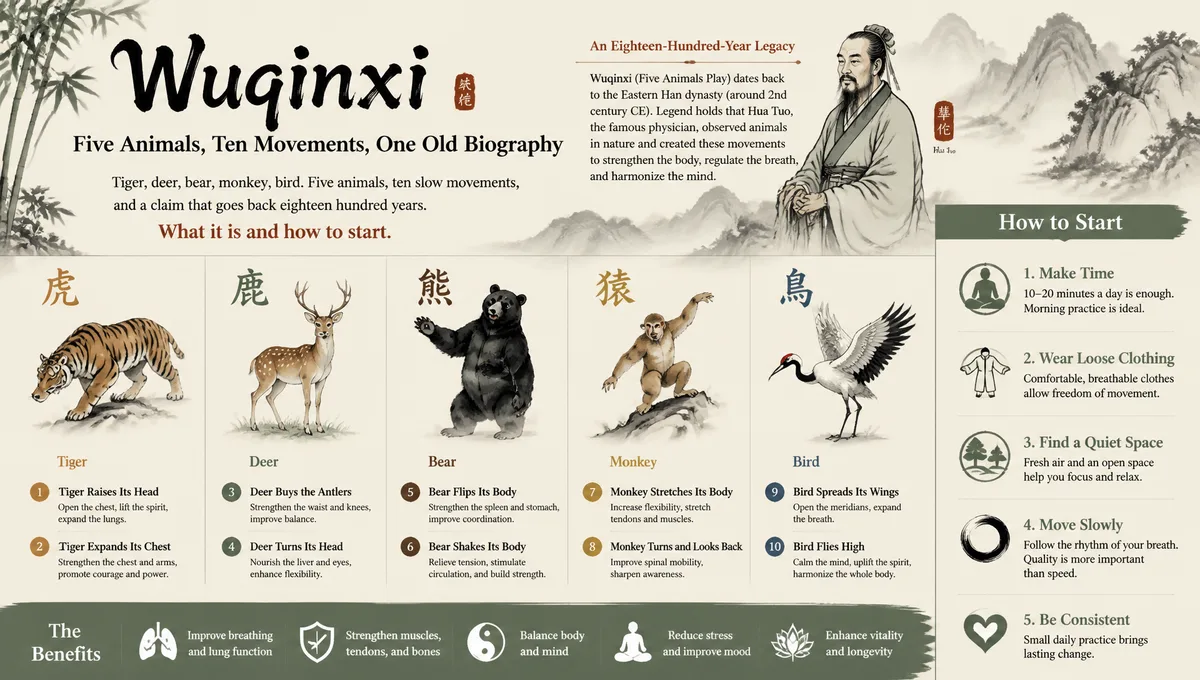
Five animals. That is the whole idea, and it is older than almost anything else you will see in a park at seven in the morning.
Wuqinxi — the five animal exercises, sometimes translated as the five animal frolics — is a set of slow movements. Each one is modelled on an animal: tiger, deer, bear, monkey, bird. The tiger stretches and sinks. The deer turns. The bear settles. The monkey reaches. The bird balances.
A full round of the modern version takes ten to fifteen minutes, needs no equipment, and fits in a room the size of a dining table.
Where It Comes From
The practice is credited to Hua Tuo, a physician of the second century whose biography is preserved in the Book of the Later Han. The biography puts the set in his own words. Five animals — tiger, deer, bear, monkey, bird — done when the body feels out of sorts, until a light sweat comes.
It also records a disciple, Wu Pu, who practised it and, according to the same text, kept his hearing, his eyesight and his teeth into his nineties. Treat that as a story the text tells about its own subject. It is not a study, and eighteen hundred years of retelling has not turned it into one.
What the passage does establish is the shape of the thing: five animals, gentle movement, done regularly, in place of anything more strenuous.
The Five Animals
Each animal has two movements in the set standardised in China in 2003, which is the version most videos teach. Older family lineages carry more, sometimes dozens, so what follows is the common modern core.
Tiger. Two movements: hands rising with the fingers spread like claws, then a forward pounce out of a deep stance. This is the most athletic part of the set — wide feet, strength through the legs, a long stretch down both arms.
Deer. The deer turns and twists. The spine rotates while the hips stay square, one arm tracing up and across. Most people feel this one the next morning, in the ribs.
Bear. Heavy, round, slow. The weight shifts from leg to leg with the upper back rounded and the arms hanging loose. Nothing here is fast, and nothing is high off the ground.
Monkey. The smallest and quickest movements in the set. Heels lift, hands gather as if picking fruit, the head turns to look. Monkey work is about lightness, and it is the only part of the routine that feels like play.
Bird. The arms open and close like wings, one leg lifts, balance gets tested. The bird closes the set because it is the calmest of the five.
Names and Claims
The biography’s line about driving off what ails the body has travelled a long way in eighteen centuries. It should be read as a second-century claim about a second-century practice, not as a description of what the movements will do to you.
Here is the plain version. Wuqinxi is slow movement through a wide range of positions: squatting, twisting, reaching, standing on one leg. That covers leg strength and balance, and it is gentle enough to do without changing clothes.
Beyond that, the tradition’s claims run ahead of the evidence. Small studies of qigong exist, mostly with modest numbers and short follow-up. Encouraging, not settled.
One caution is particular to this practice. The tiger and the bear use deep, wide stances. If your knees complain on stairs, start with the deer and the bird, and keep the stances narrow until the legs have caught up.
If you have a joint problem, a heart condition, or trouble with balance, ask your doctor before starting. Stop if something hurts.
How to Start
- Learn one animal a week. Five weeks for the whole set, which is faster than it sounds.
- Watch before you read. Search “wuqinxi” and follow a demonstration. Descriptions like the ones above are there to help you understand what you are watching, not to replace it.
- Keep the stances shallow at first. Half the depth, twice the control. Depth is the last thing to arrive, not the first.
- Ten minutes, same time. Morning is traditional. The park groups do it before breakfast, which also happens to be when a small room is quiet.
Wuqinxi, Baduanjin or Standing?
All three are on this site, and the choice is mostly temperament.
Baduanjin is eight fixed movements and the easiest to memorise. Standing practice is one posture held still, which is hard in a different way. Wuqinxi has the most variety per minute, and variety is what people stick with when repetition bores them.
If you want something smaller than all three, the six sounds practice is six syllables and one long exhale.
Common Questions
Is this tai chi? No, though they share a park and a pace. Tai chi is a martial form learned as one long sequence. Wuqinxi is five short animal sets, learnable in any order.
Do I have to imitate the animals? Only in shape. Nobody expects a roar. The names describe the body positions and the quality of the movement.
How long does a round take? Ten to fifteen minutes for the standardised set, at a speed that lets you breathe without effort.
Can I do it sitting? Partly. The arm and upper-body work adapts to a chair. The stances and the bird’s balance do not.
Which animal should I learn first? Deer if you sit a lot. Bear if you want something slow. Tiger if you already move well and want the stretch.
Does the order matter? In the standardised set it does, and the bird comes last. For learning, it does not. Piecemeal is how most people get started.
Five Animals, Then the Day
Start with the deer this week. Two movements, five minutes, before breakfast. Add the bear next week, then the bird and the monkey, and leave the tiger until last, when the legs have caught up.
If you want company in the same family, the five gentle qigong movements are the loosest version of this kind of practice. Everything else sits in the Wellness section.