Wellness5 min read
The Six Sounds: Six Syllables and a Long Exhale
Six syllables, each carried on a slow breath out, done standing before breakfast. What the practice is, how to start, and what the old names do not claim.
By Ming Chen — Editor & Researcher
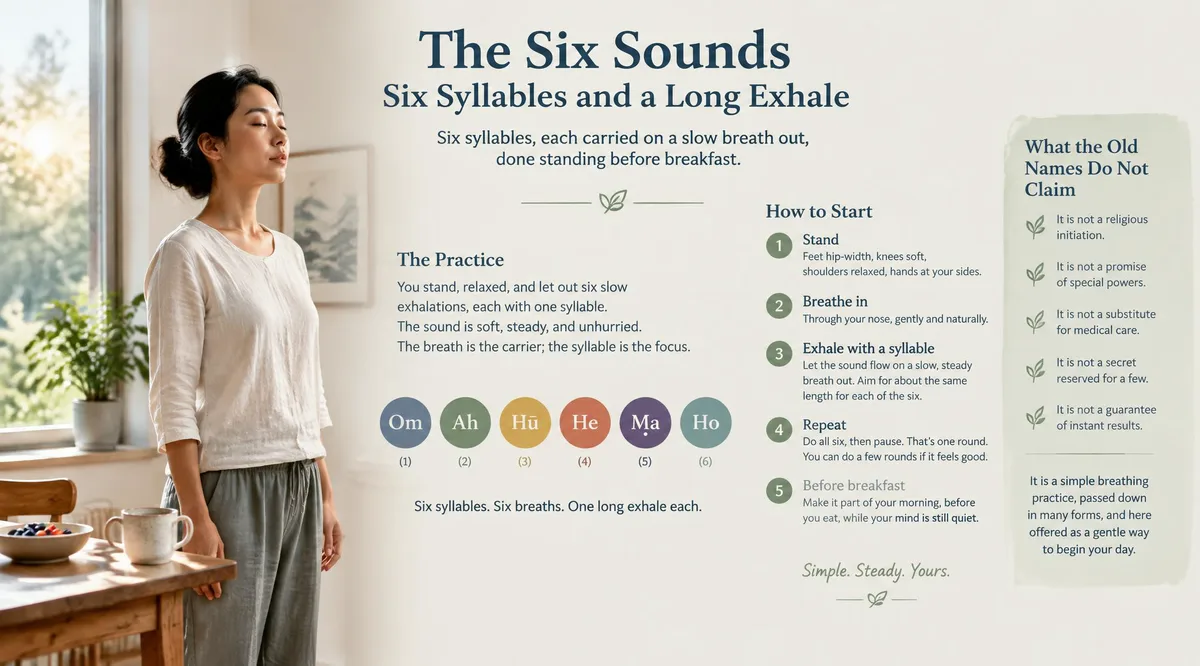
Six syllables. That is the entire practice, and it is probably why the practice survives.
You stand or sit, and you sound six syllables on six long breaths out. There is no sequence of postures to memorise, no equipment, and no level of fitness required. Ten minutes covers a full round, and a short round takes five.
In Chinese the practice is called liù zì jué, the six-character formula. English titles for it vary and none of them are wrong. Six Sounds. Six Syllables. Six-Character Practice. All three point at the same small thing.
What the Six Sounds Are
The set is usually credited to Tao Hongjing, a scholar who wrote in the sixth century, though the breathing routines behind it are certainly older. Versions have circulated in manuscript and print for centuries since. Lineages disagree about details, as they do about most old practices.
What they agree on is the shape. One syllable, held on a long breath out. Repeat. Move to the next. When you reach the sixth, you stop.
That puts the six sounds in a useful place here. Baduanjin is eight movements in a fixed order, and standing practice is no movement at all. The sounds sit closer to breathing than to exercise, which makes them the easiest entry point of the three.
The Six Syllables
Each syllable is paired, in the old scheme, with a season, an element and an organ. The pairings come from traditional theory, and this site treats them as historical labels rather than as a diagram of the body.
- Xū — the corners of the mouth pull gently back. Spring; the liver.
- Hē — mouth open, jaw loose. Summer; the heart.
- Hū — lips pursed like a tube. Late summer; the spleen.
- Sī, sometimes read xì — teeth close together, air escaping thin. Autumn; the lungs.
- Chuī — lips pursed as if blowing across a cup of tea. Winter; the kidneys.
- Xī — a smiling mouth shape, tongue relaxed. The triple burner, a term from the same old scheme.
Pronunciation need not be exact. A long, unforced exhale, with the mouth in roughly that shape, is the whole of it. Getting the vowels right is a refinement, and a teacher can supply it later if you want one.
The Exhale, Not the Sound
Strip the names away and what remains is an out-breath that runs longer than the in-breath. That is the mechanical difference between this and ordinary breathing, and it is the part worth noticing.
Inhale through the nose without effort. Let the sound carry the exhale until it finishes by itself. Do not push the last third. The pause that follows is part of the round, so leave it there.
Six rounds a day is a reasonable first week. That is about six minutes, and it will feel like very little, which is the correct feeling.
What the Old Names Do and Do Not Mean
Several of the names carry claims. One syllable is said to cool the heart, another to settle the lungs, a third to steady the lower back. Those lines appear in the old texts and are worth quoting accurately.
They are also worth reading as the poetry of a system rather than as a description of results. Chinese cosmology sorted the body, the seasons and the emotions onto one grid, and the sounds were given places on it. The names record those places. They are not instructions about what will happen to you.
What is left, once that is said, is a quiet ten-minute routine built around a long exhale. Research on slow breathing is modest and mostly small studies. Encouraging, not conclusive, and no reason to expect anything dramatic.
If you have a heart or lung condition, or you have been told to keep an eye on your breathing, ask your doctor before adding a breathing practice. Stop if you feel light-headed. Skip the voiced version while your throat is raw.
How to Start
Four points, in the order that saves the most time.
- Silent first. Mouth the syllables for a week before you add voice. Most people tense the jaw when they begin out loud.
- One sound per week. Not six. By the sixth week you will have the set and will not have to think about it.
- Six rounds each. More is not better. The count exists to end the session, not to fill it.
- Same time, same place. Before breakfast is the park tradition. Before bed works too, and some people do both.
Common Questions
Is this qigong? Yes. It is one of the quieter branches, and it appears in the same manuals as the five gentle movements and zhan zhuang.
Do I have to make a sound? No. Voiced, whispered and silent are all in use, and none of them is the beginner’s mistake.
Do I need to visualise anything? No. Some lineages add a colour or a direction to each sound. Treat those as optional layers rather than as the practice itself.
How long before it feels natural? Two or three weeks of six rounds a day. The syllables are easy. Remembering to do them is the hard part.
Can I do it sitting? Yes, and sitting is easier. Standing adds a balance element that has nothing to do with the sounds.
Does it replace walking or baduanjin? No. It is the smallest thing you can add to a day, not a substitute for moving.
Six Syllables, Then the Day
Learn xū this week. Mouth it on six long exhales, once, before you do anything else in the morning. Add hē next week. A month from now the full set will be there, and the practice will take ten minutes of a day you were going to spend anyway.
If you would rather move, start with baduanjin, or with the five animals if you want more variety. If you prefer stillness, take standing practice and its companion piece on the knees. Everything gentler lives in the Wellness section.