Arts6 min read
Chongyang Cake and Chrysanthemum Wine: What the Double Ninth Table Holds
Why the Double Ninth has a cake and a wine of its own: what the nine layers mean, why the jar waits a year, and how to steam a simple version at home.
By Lian Zhao — Copy Editor
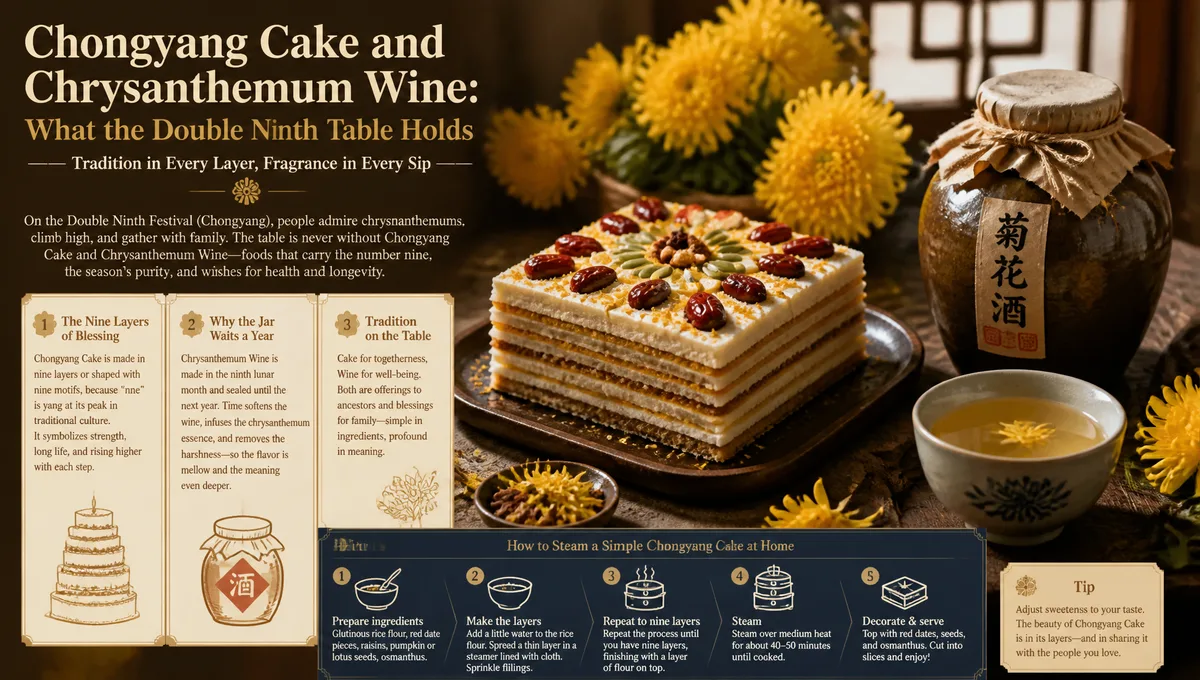
The Double Ninth is a climbing festival. That part everybody knows: walk up a hill, look at the distance, eat something afterwards. The eating is where the day becomes specific.
Two things belong on the table, and both are older than the holiday’s modern branding. One is a cake built in layers. The other is a jar of wine that was filled twelve months earlier.
Why a Cake Is Called “High”
Chinese festival food rarely explains itself. This one does. The word for cake, gao, sounds exactly like gao, high. A cake on the ninth day of the ninth month is a wish in edible form: bu bu gao, step by step, higher.
Once the pun is clear, the shape follows. Traditional cakes were built in layers, nine where a family could manage it, tapering like a pagoda, with a small paper flag pressed into the top. That flag has its own name, chongyang qi. In Ming-era Beijing, cake shops flew coloured flags over their doors and sold the things by the stack. Married daughters were expected home for a slice, and a family that failed to send for her heard about it.
The Cake Itself
What counts as chongyang gao depends on where you are standing.
In the north, hua gao is two thin layers of dough pressed around candied fruit, dates and walnuts, then steamed and cut into squares. Along the lower Yangtze, the cake is mostly rice flour, soft and pale, scattered with red and green candied threads and dried osmanthus. In Guangdong, a spongy song gao takes the place: lighter, sweeter, cut in thick slabs.
The shared thread is a method rather than a recipe. Rice flour, a sweet layer through the middle, fruit and nuts on top, and steam. Nothing is baked. Nothing needs an oven.
What you buy in a shop today is usually the Yangtze version, packed cold in plastic and meant to be reheated. It is fine, and it is not the same thing. A steamed cake eaten within a few hours of the basket has a texture the cold version cannot hold. That is the honest argument for making one yourself once a year.
Sending a Cake, Not Just Eating One
The older etiquette was about delivery rather than appetite. A cake went to a daughter’s in-laws, to parents, to a teacher. The giving carried the wish as much as the eating did, and shops wrapped the stack in paper with a red band so it would arrive intact.
There is a cheap modern version of this. Steam or buy one cake, cut it, and carry a piece to the person on your street who no longer climbs hills. The message does not need explaining: gao, higher, for you as well.
Chrysanthemum Wine and the Year-Long Wait
The second item is the one almost nobody makes now.
Juhua jiu, chrysanthemum wine, was brewed at one Double Ninth and opened at the next. Chrysanthemums picked on the ninth day went into rice wine or grain spirits with rock sugar, and the jar then sat for a year. By the time it was poured, the flowers had given up their bitterness and left only scent.
The story most often told about it involves Tao Yuanming. He spent a Double Ninth sitting among his chrysanthemums with no wine in the house. A local official who admired him sent a servant dressed in white with a jar, and the poem that followed fixed the pairing for good.
You will not find this in a supermarket. A fair substitute is juhua cha, chrysanthemum tea, served warm with a little rock sugar. Same flower, none of the wait.
Dogwood, and the Third Thing on the Table
Zhuyu is not food, but it sat on the same table. Small bags of the berries were sewn and worn at the waist or upper arm, and some families steeped the berries in the wine instead.
Wang Wei’s line — bian cha zhu yu shao yi ren, “we all wore dogwood, and one of us was missing” — is why most people have heard of the plant. Notice what the line does with it. The ritual object is not the subject. The empty place is.
Crabs, in the Ninth Month
Along the Yangtze, the Double Ninth also opens crab season. The saying is jiu ci shi xiong: female crabs in the ninth lunar month, males in the tenth. Steamed, with vinegar and ginger, they suit the holiday better than any cake does.
This is a table custom and not a rule. If crab is not on your table, nothing about the day is lost.
Making a Simple Cake
A home version needs no nine layers and no flag.
Mix 200 g rice flour with 50 g glutinous rice flour and enough water that the mixture holds together when squeezed. Sieve it. Spread half in a lined steamer basket, add a layer of red bean paste, cover with the rest, and smooth the surface. Scatter dried osmanthus, raisins or chopped walnuts on top. Steam for 25 to 30 minutes, then rest ten minutes before cutting.
Two adjustments make it easier. Sugar can be halved without hurting anything, because the fruit carries the sweetness. And a 20 cm basket is enough for six people. This is food for sharing rather than for keeping.
What to Keep, What to Skip
Keep the pun, the layers, and the flag if there are children at the table. Keep the habit of sending a piece to someone who cannot come.
Skip the year-long wine if you do not drink. Tea does the same work. Skip the nine layers if the afternoon is short: three will do. And cut the cake small for older guests, since rice flour is filling and a large wedge sits heavily after a big meal.
Common Questions
Is chongyang cake the same as nian gao? No. Nian gao is pounded glutinous rice, dense and chewy, eaten at New Year. Chongyang gao is steamed rice flour with a filling, softer, and belongs to autumn.
Why nine layers? Nine is the number of the day, and the stack echoes a pagoda. Most home versions never reach nine. The shape is a gesture, not a requirement.
Can I buy chrysanthemum wine today? Rarely, and what is sold is usually sweetened. Chrysanthemum tea is closer to the original than a commercial sweet wine.
What is dogwood, exactly? Zhuyu is the fruit of an aromatic shrub. It is bitter enough that it went into bags and wine rather than into dishes.
Is the cake vegetarian? Most versions are. Check the filling: some northern ones use lard in the dough.
Two Things on a Table
A festival that asks you to climb a hill is really asking for the year’s last good afternoon outdoors. The cake and the wine are what you carry back down.
If you want the day itself, with the climbing and the dogwood and the line from Wang Wei, it is in the Double Ninth piece. The flower behind the wine has its own article, and the fortnight around it is covered in Cold Dew and the twenty-four solar terms.