Wisdom5 min read
A Wu Wei List for the First Year of Retirement
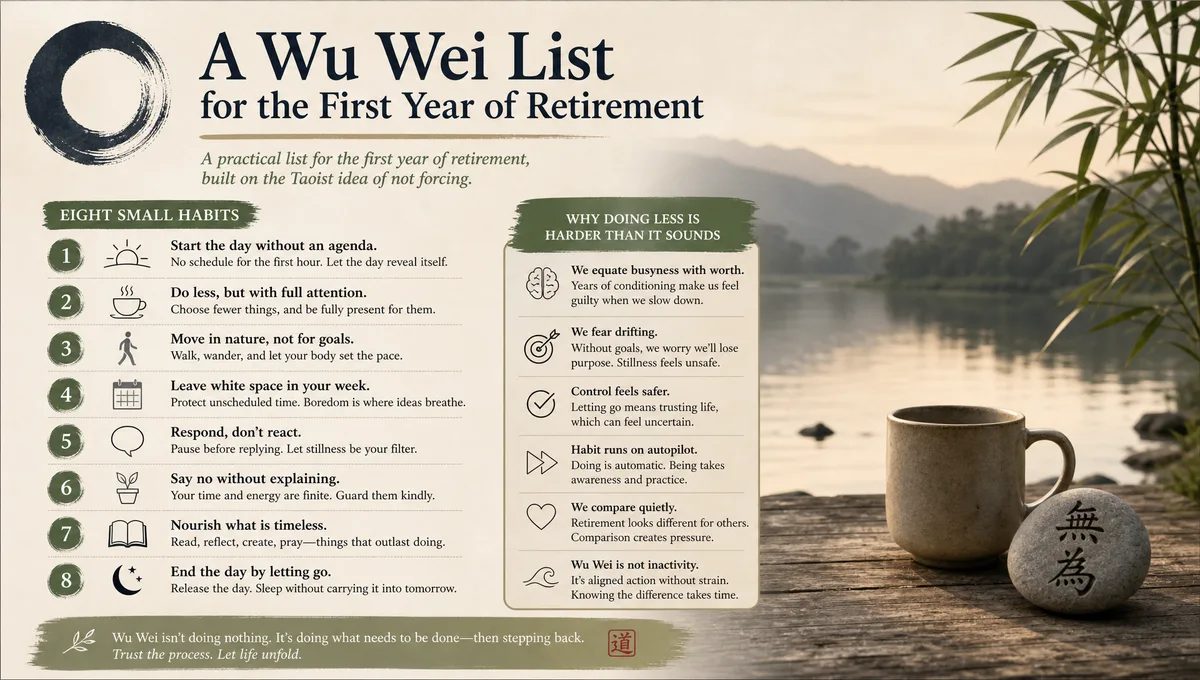
A practical list for the first year of retirement, built on the Taoist idea of not forcing. Eight small habits, and why doing less is harder than it sounds.
By Lian Zhao — Copy Editor
Most retirement advice is a productivity plan wearing a cardigan. Take up a language, join three groups, volunteer twice a week, keep busy.
The Taoist tradition offers the opposite instruction, and it is harder to follow than any rota. Wu wei is usually translated as non-action, which is wrong in a specific way: it means not forcing, not adding effort that turns work into conflict.
For the first year after a working life ends, that is the useful idea. Here is what it looks like as a list.
Why the First Year Is Awkward
For thirty or forty years, other people set the measure of your days. The phone rang with requests. Someone else decided what counted as a good week.
Retirement removes the measure faster than it removes the habit. That is why the first year often feels less like freedom than like a missing wall. Nothing is wrong with you; the instrument you were using went out of scope.
Our reading of three chapters of the Tao Te Ching covers the passage that speaks to this directly: know what is enough, and know when to stop.
The Eight Habits
None of these is a rule. They are the moves that tend to help, in roughly the order they become possible.
- Do not fill the calendar in month one. Empty days feel like failure at first. Give it three months before you decide anything permanent.
- Keep one thing that produces nothing. A garden you do not photograph, a language you learn badly, an hour of walking with no purpose. Zhuangzi’s useless tree is the parable for it.
- Practise saying no to one request a week. The first refusals feel rude. The practice is what matters, not the score.
- Do one thing at a time. Folding laundry while listening to a podcast while planning tomorrow is a habit of work, not a law of nature.
- Do not volunteer advice unless asked. This is the most difficult item on the list, especially with family. Water benefits things without competing.
- Find an unhurried group of people. Slow people are found at libraries, allotments, bird-watching hides, repair cafés and morning pools.
- Keep one small obligation. Total freedom is disorienting; one weekly commitment keeps a shape without becoming a job.
- Re-decide once a year. Nothing on this list is meant to last. Compare what you wanted in January with what you actually enjoyed.
What Wu Wei Does Not Mean
Three misreadings arrive quickly, and it is worth heading them off.
It is not passivity. Nothing above asks you to sit still. Habits four and seven are work; they are just work without the extra push.
It is not an excuse to drift. The list requires attention, decisions and refusals. Drifting is what happens when nobody is deciding anything.
It is not a claim about health. This is a way of ordering days, not a regime, and it has no promises attached. Our wu wei in daily decisions guide covers the wider idea.
The Hardest Item
Item five — not offering advice unless asked — is where most people fail, and the failure is well meant. A lifetime of competence produces the urge to solve.
Two small mechanics help.
- Ask a question instead of giving an answer. What are you thinking of doing? keeps the decision where it belongs.
- Wait a day. Most advice loses its urgency overnight, and the advice nobody needs is usually the advice that came fastest.
The same habit protects the family relationships that retirement suddenly puts back at the centre of the week. Our piece on face and the step down describes the same instinct from the Chinese social side.
A Year, Not a Doctrine
The reason to review on a schedule is that the first year produces bad data. In week three, an empty Tuesday feels like a problem. In month six, it is often the part of the week people protect.
So the list is meant to be used loosely and re-used annually. What changes is not the advice but the person holding it: the measure that used to arrive from outside slowly gets built at home.
Common Questions
Is this psychological or health advice?
Neither. It is a set of practices drawn from a philosophical tradition, written for readers deciding how to spend their days. Anything medical belongs with your own doctor.
Do I have to read the Tao Te Ching to use it?
No, but the ideas come from there, and the book is short. Two chapters are enough to get the sense of it.
What if I enjoy being busy?
Then be busy. Wu wei is about not forcing, not about being idle, and a full week that feels light is exactly what the tradition describes.
What is the difference between wu wei and laziness?
Effort that fits the situation versus effort that fights it. Laziness avoids the work; wu wei does the work that is actually there.
When does the first year stop being awkward?
Personal answers vary. Most people who describe the transition comfortably put it between twelve and twenty-four months, and the ones who struggled tend to be those who filled month one completely.
Keep the Shape, Drop the Shoulders
The first year of retirement is less a holiday than a change of instrument. What was measured from outside has to be measured from inside, and that takes longer than a calendar suggests.
The list is small on purpose. One thing that produces nothing, one weekly obligation, one refusal a week: that is already a shape. Everything else can be decided later, which is the whole point of the tradition it comes from.
More of this is in the wisdom section, including the proverbs about time and a slower reading of Zhongyong.